
Edo is the time period which ruled Japan from 1603 to 1867/68. It was a time ruled by the Tokugawa Shogunate, these approximately 250 years were generally peaceful. Civil war never again erupted in the country during this period although there were still rebellions of some kinds. This stability, the ordered nature of the class structure and the policy of isolation in Japan provided a context where the economy could develop and the arts could bloom. It was certainly not a free, equal or fair society and that is arguably true of ours today as well.
SHOGUN
The Edo period started with the Tokugawa Shogunate. Tokugawa Ieyasu was named Shogun, the head of the military, and the capital of the country moved to Edo (now Tokyo). The Shogun was basically a military dictator who was theoretically selected by the emperor but the Shogun was the real ruler in terms of power. Shogun could be inherited through family. Throughout the Edo period the Shogunate was held within the Tokugawa family. He ruled through his advisors who were also called bakufu (“tent government”).
DAIMYO
The daimyo were the local rulers, the lords upon whom the shogun’s power depended. Japan was a feudal society; the daimyo were the lords of the land which they held at three levels: based on their relationship to the Tokugawa clan. Originally many of the daimyo made their fortunes out of taxes imposed on farmers. However, the extravagance of the daimyo leads to a large number falling heavily into debt to the merchants. This, somewhat ironically, was a class that received no taxes because they engaged in what Japanese society saw as one of the most ‘parasitic’ activities-trade.
SAMURAI
A samurai was a warrior, he could be employed by the shogun himself, or be a vassal to a daimyo. They owned nothing, and did no physical labor for it was beneath them. Warfare was the only thing a samurai practiced, and seeing as it was peaceful there was not a lot of it, a lot of them went into arts and education instead. They could not find work as samurai after the Edo period, and became administrators or entrepreneurs.
SANKIN-KŌTAI
Sankin-ktai was a policy which meant that the daimyos had to take up residence in Edo for a year every other year, while their wives and children lived there continuously. Sankin-ktai ensured central control and was a form of hidden hostage-taking which prevented the daimyos from rebelling. In addition to this the policy drained daimyos of money since they were now required to maintain two residences in Edo which had to be lavish and, therefore the daimyos could only have a limited amount of money at their disposal to start any form of rebellion.
SAKOKU AND RANGAKU
Sakoku was a policy of isolation adopted in the 1630’s. No foreigners allowed to enter Japan (death penalty if they entered). No Japanese allowed to leave and enter if they wanted to. Exceptions were Dutch trading post located on Dejima (an artificial island) off Nagasaki (which was considered foreign territory) and trade with China through the same port.
Rangaku or ‘Dutch learning’ was the study the Japanese took from their interactions with the Dutch on Dejima which kept Japan up to date with Western science and technology (this was to be essential during the Meiji Restoration).
HANKŌ AND TERAKOYA
Han schools were institutions of the daimyo government, which were dedicated to the education of daimyo and samurai sons, from the initial study of Confucianism to other subjects such as Japanese literature, medicine, mathematics, and martial arts. Terakoya was a private institution of learning for the commoners – for the wealthy merchants with no social status. Initially taking place in temples, they taught such skills as penmanship, use of the abacus, history, geography, and aspects of everyday life.
UKIYO
Ukiyo, or the ‘floating world’, denotes the culture of entertainment in the cities during the Edo period. The growing period of peace and the increasing affluence allowed for leisure, and the merchants – the lowest status in the hierarchy, but highest benefactors of wealth – flocked to see kabuki, geisha, and the brothels. The word ‘Ukiyo’ soon took on the meaning of this hedonistic lifestyle focused on Yoshiwara, the official pleasure district of Edo.
UKIYO-E
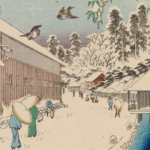
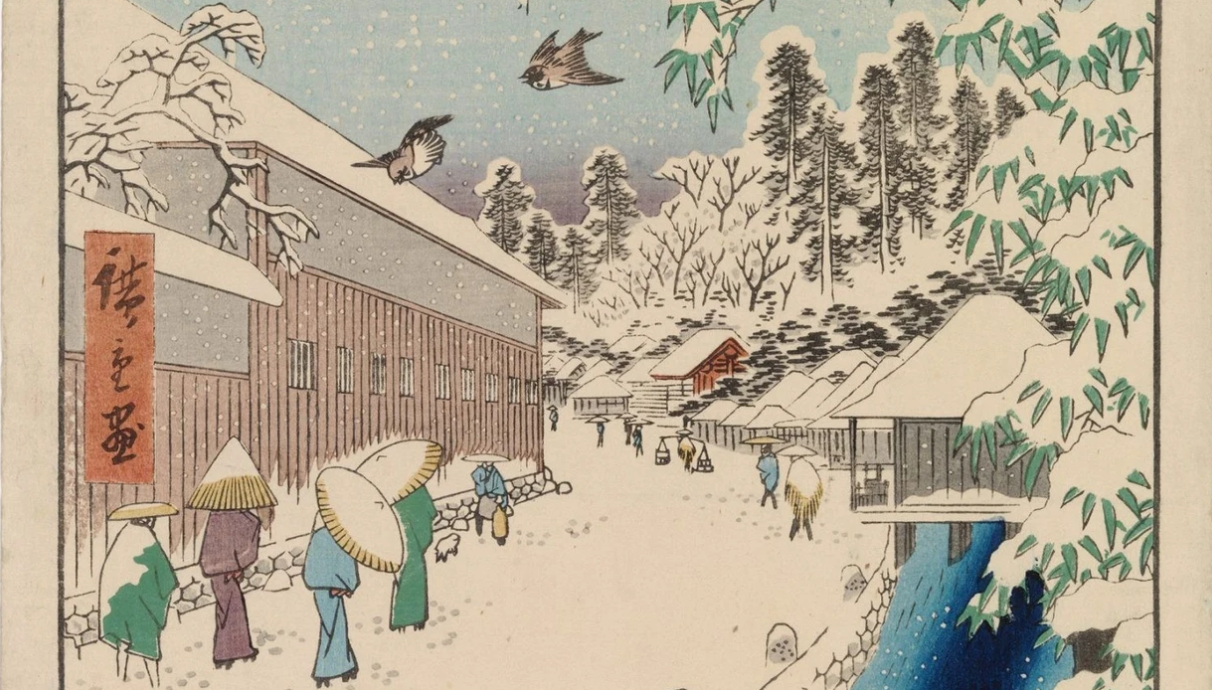
Ukiyo-e is the style of woodblock prints that emerged with ukiyo culture. The subject matter was enormous: courtesans, Kabuki stars, nature, flowers, sex, and anything else that would entertain and enthral. Hishikawa Moronobu, one of the earliest masters, was the pioneer of monochrome and hand-colored prints, as this pre-dated multicolor printing, and by the 18th century Utamaro and Sharaku had catapulted this medium into mass popularity. The art form flourished throughout the 19th century with prints like Hiroshige’s Fifty-three Stations of the Tokaido and Hokusai’s The Great Wave off Kanagawa.
KABUKI
Kabuki started early in the Edo period, probably in form of a female troupe established by Izumo no Okuni. What is remarkable about the founder is that the performing arts, and Kabuki in particular, have been forbidden to women since 1629. High theatrical acting, spectacular costumes and heavy, expressive kumadori stage makeup are characteristic of kabuki, which was particularly popular in Yoshiwara, played a significant part in ukiyo culture and uniquely brought together audiences from all the social stratas.
BUNRAKU
The traditional Japanese puppet theatre of Bunraku was established in Osaka in the early seventeenth century and included three distinct forms of performers: the puppeteers (ningyzukai), the chanters (tay), and the shamisen player. Bunraku puppets can be extremely complex, and possess moving eyes, mouths and eyebrows, or even changing face-designs to create demons in the middle of the play. Similar themes were used in both Bunraku and kabuki, and plays were often adapted from one to the other. The artform has strong associations with tales of suicide by lovers, and the story of the 47 ronin.
THE RINPA SCHOOL
This school emerged in the early Edo period to satisfy demands from merchants and clients who valued decorative arts; Rinpa artists created screen paintings, fan paintings, lacquer objects, ceramics, textiles, clothing. Simple motifs of nature (birds, plants and flowers), set against gold-leaf backgrounds were often employed. Early masters were Hon’ami Koetsu (1558-1637) and Tawaraya Sotatsu (d. C.1640). Together they fused calligraphy and pictorial art and gave their paintings a strong rhythm and sophisticated taste. Revived in the Genroku era (1688-1704) by Ogata Korin and his brother Ogata Kenzan; this movement tended to incorporate more abstract representations of natural motifs as well as liberal use of gold and mother-of-pearl.
THE KANO SCHOOL
From the late fifteenth century to the Meiji period, the dominant style of Japanese painting was that of the Kano school which was directly patronized by the shogunate, being its official art. The school drew on the techniques of Chinese ink painting, but combined them with heavily pigmented, gold leaf compositions suitable for large screens and sliding doors. Founded by Kano Masanobu (1434-1530), the most famous painter of the school was Kano Eitoku (1543-1590), who is also responsible for establishing the use of gold leaf background for large works. Subject matters include animal or dragon landscapes, trees and birds, aerial views and so on.
THE BUNJINGA / NANGA SCHOOL
Bunjinga(also Nanga,or ” Southern Painting”) was based on Chinese literati amateur painting of the Yuan dynasty, which was transmitted to Japan in the mid-18th century. Such paintings are usually rendered in black ink, sometimes with light colors, in Chinese-style landscapes with integrated poems and inscriptions, which were written by not the artist but his friends more often. Prominent artists: Ike no Taiga, Uragami Gyokudo, Yosa Buson etc.
ZENGA
Zenga is the Zen painting and calligraphery that were popular during Edo period. The artworks often combine pictures with writing: the writing, in calligraphy form, represents a teaching of Zen Buddhism while brushwork is of strong, simple and abstract style. The most used symbols were theen- a hand painted circle meaning the universe and nirvana- and staff and Mount Fuji. Theen is usually painted by one or two unrestrained brush strokes at the moment of mental liberation and represents an essence of the Japanese aesthetics-minimalism.
The art of the Edo period was so enriched and vibrant that the short description here cannot possibly encompass it all. We hope that it served as a small insight to the great age where Japan shut the country off and prospered through its own capabilities. Its art was original enough to inspire western artists and make their works renowned too.