
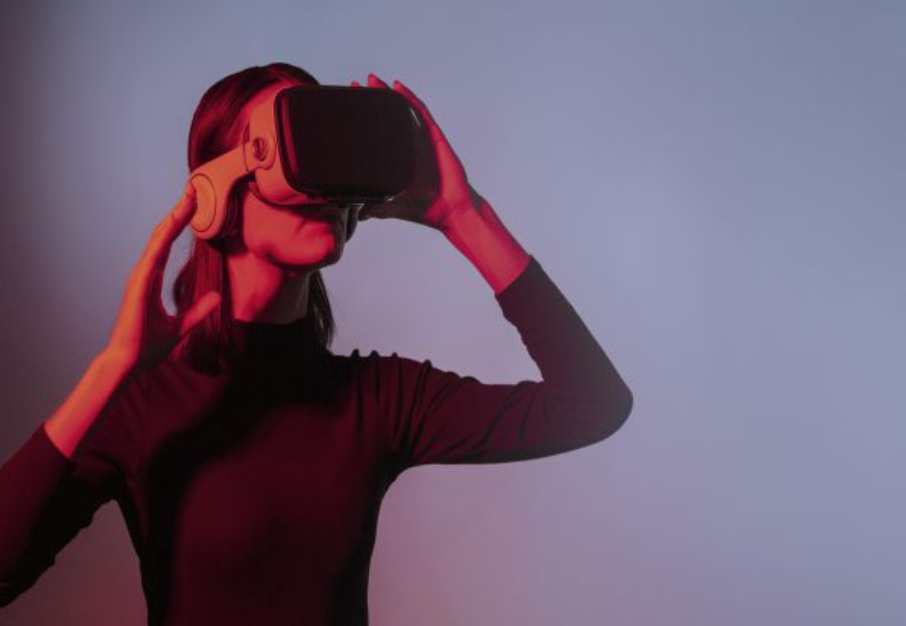

A fascinating new study has found that using virtual reality can trigger remarkable changes in the brain — specifically in how it processes and categorizes what counts as part of the body.
Volunteers who were equipped with the virtual wings for several hours in the experiment started mentally attributing those wings to their bodies in a way very similar to the way the brain attunes to real body parts. The results demonstrate how pliable and flexible the human brain is in amazing ways.
The Science Behind It
A region of the brain called the occipitotemporal cortex handles the visual processing of body parts. Scientists believe this area is essentially “hardwired” through hundreds of thousands of years of evolution to recognize specifically human limbs — hands, feet, arms — as belonging to the body. The new study, conducted by researchers at Peking University in China, set out to test how this region would respond when people were given something it had never encountered in the course of human evolution: large, feathered wings.
Twenty-five volunteers took part in the experiment, completing four 30-minute VR training sessions over the course of one week. During these sessions, participants were given tasks such as flying through rings in the sky. Perhaps the most interesting aspect was that the virtual wings fully took over the use of hands within the VR space – people saw only the wings, instead of their hands. The wings themselves were modelled after accurate air-foils.
The Brain Rewrites itself
Functional MRI scans compared both before and after the training period, revealing a surprising result: the occipitotemporal cortex had indeed been “rewritten”. After the training sessions, it responded more strongly to images of the VR wings than it had before. More significantly, the neural pattern associated with the wings had become similar to the pattern the brain uses when observing human hands — particularly in the right hemisphere, which is generally responsible for processing visual representations of non-hand body parts.
On top of this, the occipitotemporal cortex showed stronger communication with the frontoparietal regions of the brain — the areas involved in planning and coordinating movement. In essence, the brain was not just seeing the wings as something interesting to look at, but as something to plan for and control, as if it were really an arm or leg.
The researchers were careful to say that they are not suggesting that the wings actually became part of the brain’s representation of the body, but they do state that the neural activity became considerably more like the kind of neural activity provoked by actual body parts-a significant, yet more subtle finding than the wings completely incorporating into body schema.
The Significance of This Finding
Prior research had demonstrated that the brain seems to always maintain a boundary between the human body and the external objects used with or attached to it, whether tools or artificial limbs; it is always something to be controlled, not a part of the self. This VR wing study has shown that immersion in virtual reality is capable of blurring that line in a way that inanimate objects are not.
The possibilities are widespread. The researchers are hopeful their results might lead to better physical therapy, for example, the development of stronger neural pathways to prosthetic limbs in amputees. They also open up broader questions about long-term VR use and what sustained immersion might gradually do to our brains.
“In the future, we may spend a great deal of time in VR. We are very interested in what that could mean for the human brain,” said psychologist Kunlin Wei from Peking University.
The study is a reminder that the brain, shaped as it is by millions of years of evolution, remains deeply capable of adapting to experiences that would have been entirely unimaginable to our ancestors.