

A Strange Discovery in the Deep Ocean
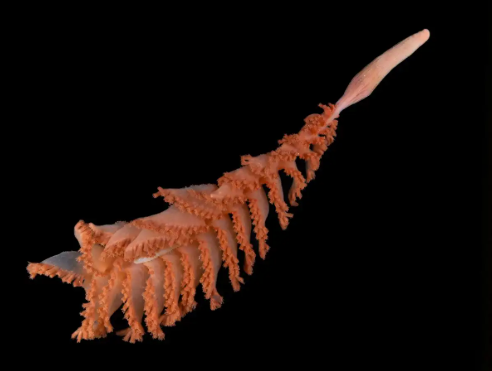
While most people might think of sea cucumbers, blob fish or other deep-sea curiosities, scientists are still finding remarkable life forms, thousands of feet below the surface of the ocean, in regions never reached by sunlight. Their most recent discovery is a peculiar and delicate sea pen, observed on an isolated feature at the bottom of the ocean called Mystery Ridge. The strange creature can almost be perceived as unnatural; it has an organic look and at first, it looks like a quill or a glowing feather anchored into the sea bed. But actually, it is a living creature. The sea pen belongs to a family of soft corals known as “colonial polyps” that form a structure together.
What Exactly Is a Sea Pen?
Sea pens are animals that live in the sea. They are part of the same animal group as the hard corals, however while the hard corals create the coral reefs, sea pens are soft animals and can move freely. They are called sea pens as they look like the quill pens that people used to write with if they are upright and plunged into the sea bed. A single sea pen is a colony of tiny creatures called polyps which can all carry out their own specific role in the colony. Some feed, some reproduce and some help to circulate water etc. So, the whole organism can function as one unit. Sea pens are rooted to soft substrate on the sea bed, but hold themselves erect in waters where the currents carry food particles.
The Unique Environment of Mystery Ridge
The Mystery Ridge is an deep sea geological feature. This feature is relatively untouched, mainly due to it’s depth and isolated position. However, along with most other deep-sea ridges it provides a habitat for which marine animals have evolved in isolation from the environment around it. The condition for life is not ideal. It is dark, cold and there is an enormous amount of pressure, so creatures have adapted for this environment in various ways, it results in animals with unique shapes and behaviors, differing from that in shallow water environments. The finding of the sea pen in this region indicates that this feature may in fact contain many different animals, that are yet to be studied. Researchers suspect that these undersea regions can be biological hotspots, and will contain animals, still to be discovered.
Why Sea Pens Are Important to Marine Ecosystems
In the deep-sea environment, sea pens play an ecologically significant role. As filter feeders, they help in maintaining equilibrium in the environment by filtering the tiny particles and plankton from the water column. They act as habitats for various other marine lifeforms such as fish, crustaceans, invertebrates as they offer protection to these animals from potential predators; hence considered as important structural formations on the sea bed. Further, they play a part in the nutrient recycling within the deep-sea habitat by extracting organic matter from the water and sediment, circulating the energy through the marine food chain. They are also often indicators of ocean health as they are susceptible to various environmental conditions. Changes in the deep-sea environment can have profound impacts on sea pen populations, and can potentially be attributed to changes in climatic conditions or human disturbances.
What Makes This Sea Pen “Weird and Wonderful”
A new sea pen discovered on Mystery Ridge is quite a peculiar find due to its unique look and structure. Though all sea pens have the same basic template they have discovered features in this species not seen before. Marine Biologists said the unique look is likely a adaptation to its unique surroundings; in low light conditions sea pen species will exhibit unique qualities like being bioluminescent or having improved feeding organs. The specimen in question appears particularly alien looking and fragile and has earned much regard from Marine biologists as one of the most eye catching new species discovered.
How Scientists Study Deep-Sea Creatures
Observing and documenting deep-sea life like the sea pen is very difficult given their habitat-it’s both deep and requires pressure to survive, so there aren’t many tools to study these creatures other than deep-sea submersibles and ROVs. These robotic devices are equipped with various sensors, cameras and mechanical arms that can document a species without upsetting an entire ecosystem. High-definition imagery has also become critically important, because it has been noted that most deep-sea creatures are too frail to be taken to the surface. After the research is brought to land, samples and images are then compared, and scientists determine if it’s an already discovered species, or if there’s an entirely new organism.
Why Deep-Sea Discoveries Matter
Findings such as the Mystery Ridge Sea pen are important not just scientifically but to grasp biodiversity on Earth. One of the most unexplored areas on the planet, the deep ocean is home to a plethora of species which have vital ecological functions on Earth. Such investigations enable us to identify adaptation mechanisms required to survive in severe habitats; which in turn have implications in global climate, evolution, even the possibility of extraterrestrial life. The deep ocean also has a function in Earths’ carbon cycle, organisms in it remove carbon from the environment, store it within the sediments of the ocean floor.
Threats Facing Deep-Sea Ecosystems
Even though the deep sea seems like an out-of-reach and unpolluted environment it is rapidly being encroached upon. Pollution, climate change and deep-sea mining are all posing a threat to the environments of the deep sea.
Species living in the deep sea often grow slow and reproduce in small numbers and they are therefore more sensitive to changes. Environments which are damaged by human activity may not fully recover for decades or centuries.
Unique species such as the Mystery Ridge Sea pen can only emphasize the importance of the preservation of these areas before they have been fully discovered. Scientists say that protection efforts should be aimed at the areas of the world that remain unexplored so that biodiversity is not wiped out without us even knowing it is there.
The Future of Ocean Exploration
Technological advancements in oceanic research are enabling the discovery of new species at an increasing rate. Recently, extensive international missions have uncovered hundreds of unclassified marine life forms. Robotics and AI-powered image analysis and genetics are revolutionizing marine sciences as robotic vehicles are used to map entire ecosystems and identify new species more quickly than humans. Scientists predict that, in the coming decades, many thousands of marine species will be discovered as continued exploration yields even greater results than the findings from areas such as Mystery Ridge.
Conclusion
This amazing discovery of a strange sea pen on Mystery Ridge just shows how much of our ocean is left to explore. Below the surface we have a world that is so vast and mysterious filled with creatures that continue to Amaze scientists. This ‘weird and wonderful’ sea pen is not just a peculiar animal it is part of an even larger ecosystem that we are still only just starting to comprehend. The more and more we are finding it is helping to paint an ever-clearer picture of this world. With ever improving technology and ever-expanding explorations we are bound to find more and more strange creatures dwelling at great depths