
Every April, something remarkable happens along the rocky coastlines of the North Atlantic. After spending months alone at sea, thousands upon thousands of small black-and-white birds with vivid orange beaks begin to gather on the water. Then, almost as if on cue, they lift off the surface and start circling the cliffs and grassy hillsides below. The Atlantic puffin has come home.
For most of the year, puffins are creatures of the open ocean — solitary, windswept, and virtually invisible to the human eye. But for a brief and breathtaking window each spring and summer, they return to land to breed, nest, and raise their young in dense, noisy colonies that draw wildlife watchers from around the world. If you have never witnessed it, this is the year to change that.
Why Puffins Return to Land Each Spring
Atlantic puffins are seabirds in the truest sense of the word. If they could get away with it, they would remain on the sea their whole lives. The only thing strong enough to pull them back to land is the urge to breed — and even then, it appears to be something of a forced return.
Kenny Taylor, a conservationist and self-described puffinologist who has been researching puffins in Scotland for half a century, sums it up best. You can just see them coming towards the land, he says — a visible conflict playing out in a seabird caught between instinct and necessity. If they could bring up their chicks at sea, they would. It seems they cannot, and so they come back every year.
Once on land, the puffins immediately set to work. They find a burrow, they find a mate — and often in exactly the same place as the year before. Puffins are famously faithful to their partners, their burrows, and their colonies. A pair can return to the same underground nest for decades, with many adults living into their 30s and some getting well into their 40s.
Where in the World to See Puffins
Iceland is the undisputed capital of the puffin world, hosting around 60 percent of the entire global Atlantic puffin population. But the birds are far more widely distributed than many people realise, and there are excellent viewing opportunities across the North Atlantic.
In North America, Canada’s Newfoundland and Labrador is home to the largest Atlantic puffin colony on the continent. The Witless Bay Ecological Reserve, located just south of St. John’s, welcomes over 350,000 puffins every breeding season, making it one of the most extraordinary wildlife spectacles in the Western Hemisphere. On the US side, the coast of Maine — particularly the restored colonies on islands like Seal Island and Matinicus Rock — offers some of the most accessible puffin viewing in the country.
Across the Atlantic, the British Isles are dotted with puffin colonies, from the Farne Islands off the Northumberland coast to Skomer Island in Wales and the dramatic sea cliffs of Orkney and Shetland in Scotland. Norway’s coastline hosts large and well-established colonies, and the Norwegian island of Lovund has made the puffin’s return the centrepiece of a beloved annual celebration.
Puffin Arrival Day: A Tradition Built Around a Bird
So many different communities organise festivals centred around the precise arrivals and departures of birds, but for the most part they all organise them around a single bird — the puffin. The island of Lovund, off the coast of Norway, has become famous for exactly this reason. Every year on April 14th, the island celebrates Lundkommdagen, or Puffin Arrival Day, marking the moment the birds return from their winter at sea.
The fact that puffins arrive at this particular time of year, every year without fail, continues to amaze scientists and bird researchers alike — and Kenny Taylor is no exception. Taylor himself had the privilege of witnessing an unusually enormous arrival of puffins on April 14th, Lundkommdagen, some fifteen years ago. For a man who had already dedicated decades to researching this remarkable bird, it was, by his own account, a truly magical occasion.
The Hidden World Beneath the Surface
One of the most fascinating and least understood aspects of puffin life is what happens underground. Unlike many seabirds that nest in the open on cliff ledges, puffins excavate their own burrows, using their powerful beaks and sharp claws to dig cavities beneath boulders and into soft hillside soil. Once a pair settles into a burrow, they may return to it for the rest of their lives.
Because so much of puffin nesting activity happens out of sight, it took scientists far longer to study this phase of their lives than the more visible behaviours at the colony surface. In recent years, cameras placed inside puffin burrows have begun to reveal what was previously a complete mystery — which predators are raiding nests, how chicks are being fed, and how the parents divide their duties.
One particularly revealing detail to emerge from burrow cameras is how the diet of pufflings — the endearing name for puffin chicks — is shifting. Young puffins have been filmed attempting to swallow fish that are far too large for them, likely because the preferred prey species such as herring have become harder to find. Warming ocean temperatures and overfishing are altering the availability of the small fish that puffins depend on, forcing parents to bring back whatever they can find.
The Remarkable Bill: More Than Just a Pretty Face
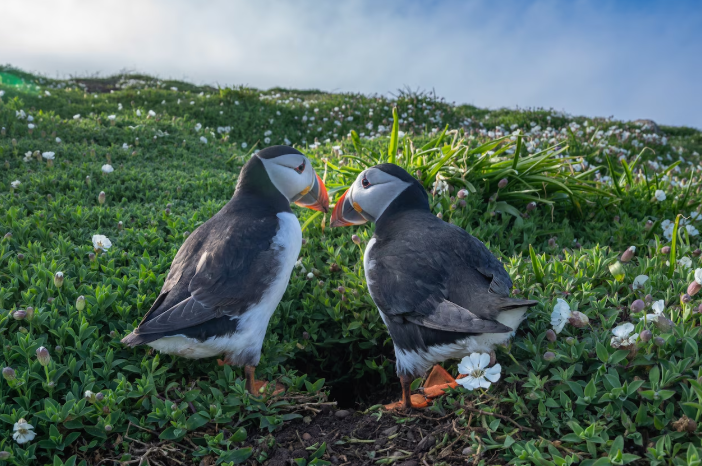
If there is one thing that makes an Atlantic puffin truly distinctive from any other bird in the world, it has to be its bill. During the breeding season it is an enormous, wedge-shaped affair blazing with hues of orange, yellow, and red — quite possibly the most unique bill in the entire animal kingdom, and it has quite a job to do.
It is, quite simply, a sign of a good mate. A bigger, brighter bill signals a stronger, healthier puffin, and it plays a central role in courtship behaviour. The birds “bill” to each other in a ritual whereby two mates click their bills together with an audible thwack while staring directly into one another’s eyes.
However, these spectacular bills only appear for a short while. Once the mating season draws to a close, the keratin plates that give puffins their vivid colouring and distinctive shape begin to shed and disappear. The eye ornamentation goes too, their bright orange feet fade to pale yellow, and their face darkens — leaving them with a noticeably smaller, sleeker, and considerably duller bill. The transformation is so striking, in fact, that earlier observers genuinely believed summer and winter puffins were two entirely different species.
Survival at Sea: Small Birds, Enormous Challenges
Despite being so loved by people the world over, puffins are hardy survivors that face many battles during the months spent away from their colonies. Out on the open ocean, a bird roughly the size of a football must compete in a world of predators both above and below the surface.
The black-and-white colouring that leads some people to affectionately call puffins “penguins of the north” is not just for appearance — it serves as camouflage, known as countershading. From above, a puffin’s dark back blends into the depths of the sea below. From below, its white belly merges with the brightness of the sky above. This dual disguise offers protection from gyrfalcon attacks from above and from sharks or other large fish hunting from below.
Even with all these natural defences, our knowledge of where puffins spend their time at sea remains rather incomplete. It is only within the past decade, thanks to advances in tracking technology, that researchers have been able to gain any real insight into the whereabouts of Atlantic puffins during their winter months — and there is still much left to discover.
Conservation: A Cautionary Tale With Reasons for Hope
The IUCN lists the Atlantic puffin as Vulnerable. Globally, populations remain largely stable compared to many other seabird species, but some colonies have declined dramatically, and the long-term impact of climate change on the fish populations that puffins depend on is a growing and serious concern.
Historically, the hunting of island colonies proved so extreme that some populations were wiped out entirely. Atlantic puffins nesting in the Gulf of Maine had almost completely disappeared from their nesting islands by the late 19th century. The National Audubon Society has been working to bring them back through a technique known as social attraction — playing recorded puffin calls and placing decoys on restored islands to encourage birds to return to places they had abandoned for over a century. The effort has worked, and puffins are now breeding again on Maine islands that had not seen a single nesting bird in more than a hundred years.
Introduced predators, particularly rats, pose a serious threat to breeding seabird colonies across the world. On some islands, rat populations have grown so large they have caused puffin colonies to collapse entirely. Rat eradication programmes, however, have proven remarkably successful wherever they have been carried out, and such initiatives are now underway across the North Atlantic, including in the UK and Iceland.
In essence, the story of the Atlantic puffin is, as one seabird biologist puts it, both a warning and a source of hope — proof that human activity can devastate a population, but that with sustained and determined effort, what was lost can be brought back.
Conclusion
The Atlantic puffin is one of nature’s most improbable success stories — a small, brilliantly coloured ocean bird that navigates some of the harshest seas on the planet, returns to the same patch of cliff year after year, and raises its young in burrows underground. Each spring, its return to shore is a reminder of the extraordinary resilience of the natural world, and of how much is still left to discover about even the most familiar-looking creatures. Whether you watch from a clifftop in Iceland, a boat off the Maine coast, or through a burrow camera on a remote Scottish island, the puffin never disappoints.