
Older than the Aztec Empire, Merton College Library at Oxford has been used by everyone from celebrated 14th-century mathematicians to J. R. R. Tolkien. In an exclusive interview with the BBC to mark its 750th anniversary, the library’s curator describes what makes it so extraordinary.
By: Christian Kriticos / BBC | Translation: Telegrafi.com
Inside Merton College, Oxford, there is an old chest. In the Middle Ages, three key-holders had to be summoned before its treasures could be revealed. But that treasure was not gold or jewels — it was books.
Such security might seem excessive for a piece of parchment. But in an age before the printing press, books were precious — each one taking months to produce by hand. And so, much as universities today seek alumni donations, Merton College required its 13th-century members to donate books.
The Archbishop of Canterbury issued a decree in 1276 enshrining this requirement, marking the founding of Merton College Library. That decree has operated continuously ever since — through the Black Death, the Renaissance, and the Covid pandemic. Users have ranged from 14th-century mathematicians to J. R. R. Tolkien.
This month marks the library’s 750th anniversary — an achievement already celebrated in the Victorian era, when it was regularly described as the oldest library in England.
In the 20th century, writers such as Rudyard Kipling and John Buchan referenced it in their work, cementing its venerable reputation. As appreciation grew, so did the claims — some Oxford enthusiasts eventually declared it the oldest library in the world.
The Origins of a Historic Library
Historians today are more careful about making such bold claims. “It is a complicated question,” says Professor Teresa Webber of the University of Cambridge. “There is no single definition of a library. And there have been many stages in the development of what we now think of as a library.”
The origins of Merton Library are certainly quite different from how we think of such institutions today. There was no librarian and no shelves for browsing. “There was a system for borrowing and returning books from the chest,” Merton’s librarian Dr. Julia Walworth tells the BBC. “It was a formal process. Rather than simply saying ‘go and find the books you need,’ the whole community would gather to open the chest.”
The Merton collection began to evolve quite quickly into something more like a modern library. Only a few years after the archbishop’s decree, some books were placed outside the chest for the first time. They were chained to a table in the college, making them accessible at any time. According to Walworth, this innovation “anticipates the modern distinction between lending collections and reference collections.”
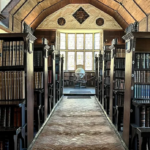
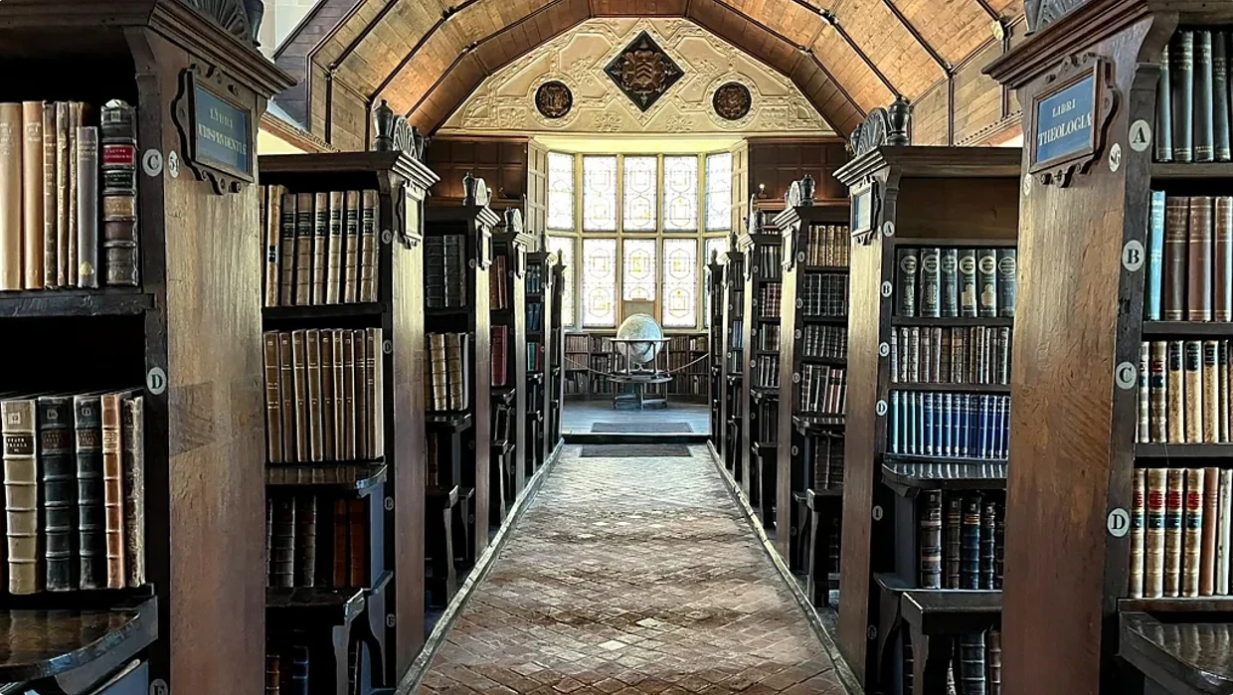
Merton’s treasury of books began its transformation into a proper library in the 1370s, when a dedicated room was built to house the growing collection. It was here that Merton introduced a significant improvement in the storage of books. “Horizontal shelves were installed for placing books vertically,” says Walworth. “Merton is the earliest documented use of this method of book storage in Britain.”
Curiously, Merton’s books were placed spine-inward, with their titles written in colour on the exposed edge. This was because of the continued use of chains, which were fixed to the front edge of each book’s cover. “Members of the college knew that chained books were more likely to survive than loaned ones,” explains Walworth.
Today, only a handful of volumes remain chained — for display only — and books now sit spines outward in the modern fashion. But otherwise the medieval room is a remarkable time capsule. Near the entrance stands the 13th-century chest Walworth believes to be the original. During term time, students still use the historic room. This continuous use is central to the superlatives often applied to Merton. “It is difficult to think of an earlier library room that has been in continuous use,” says Teresa Webber.
The Library’s Mythologisation
Claims about Merton’s age gathered pace in the Victorian era as it became a tourist destination. Visitors were captivated by its stained-glass windows and rare books, including a 15th-century edition of The Canterbury Tales — one of the earliest printed books in England, with hand-illustrated margins. The American writer Ralph Waldo Emerson mentioned it in his 1856 English Traits; in 1884, a young Beatrix Potter described its “fine oak roof” and “ancient dusty smell” in her diary.
Around this time, books and magazines were increasingly describing the library in record-breaking terms. An 1878 guide to Oxford called Merton Library “the oldest now existing in England.” The 1885 edition of the Encyclopaedia Britannica described it as “the oldest existing library in England.” Gradually, these claims grew. A 1928 article in The Times reported an event organised by the Oxford Conservation Fund at which it was declared “the oldest library in the world.”
This growing perception even found its way into The Great Gatsby. Fitzgerald’s millionaire protagonist fills his mansion with imitations of history’s most prestigious rooms — including one he calls “the Merton College Library.” As Walworth notes, “Merton Library had become synonymous with the ‘best’ ancient library.” The detail had real roots: eating clubs at Princeton contain historic imitation rooms, one modelled on Merton.
Today, Walworth resists any suggestion that Merton is the oldest library in the world, preferring to call it “one of the oldest academic libraries in continuous use in Europe.” The qualifier matters: monastic and private subscription libraries functioned differently and deserve separate categories. “Our perspective now tends to be more global, and rightly so,” she says.
The Debate Over the World’s Oldest Library
Among global institutions, several candidates exist for the contested title of world’s oldest library. When the Al-Qarawiyyin Library in Morocco underwent major restoration in 2016, some media described it as “the oldest library in the world.” The Guinness World Records, meanwhile, considers the Monastery of Saint Catherine in Egypt to be the world’s oldest continuously operating library.
In both cases, establishing a precise founding date is difficult. For Al-Qarawiyyin, some scholars have expressed doubts about claims of 9th-century origins, saying “the history has many mythical elements.” For Saint Catherine’s Monastery, the building dates to the 6th century — but ancient writings suggest library collections there may date back two centuries earlier. “It depends on how you count,” says Walworth. “When do you start the timeline? What is the beginning of a library?”
Professor Richard Gameson of Durham University believes Saint Catherine’s is “probably the one with the longest unbroken history,” but cautions that the nature and use of the library has changed enormously over time. Any claim to being “oldest” demands a clear definition — and finding one that yields a single record-holder seems nearly impossible.
“You might think of the oldest library as the oldest coherent collection that stayed together,” says Teresa Webber, “or in terms of a surviving physical space.” She cites the Dunhuang Cave Library in China: sealed around the 11th century and reopened only in 1900, its manuscripts were preserved there without interruption throughout.
Finding a shared definition of a library will only grow more challenging as digital institutions now offer physical spaces that contain no books at all. “The definition of what a library is has always needed to be broad,” says Webber. “The introduction of new technologies is simply a continuation of that. But I don’t think the library as a physical space will disappear.”
Walworth is equally optimistic as she begins a project to digitise Merton’s manuscripts. “People will be able to access them from anywhere. But I think they will still want to come and see the library and understand how people used books in the past.”
Reflecting on 750 years, this digital phase is simply another step in a long evolution — from the archbishop’s chest to chained tables to horizontal shelves to virtual space. “I find it less useful now to talk about libraries as ‘oldest,'” says Walworth. “The history is not about how long a library has functioned. It is about a sense of community.”
She notes that the tradition of book donation begun in 1276 continues today. “What began with those rules was the idea of a shared collection created by people. It is truly extraordinary that for 750 years, people have kept faith with an institution and its books.” Perhaps that is the truest measure: not age, but belonging.